Condo vs Co-op vs House: Which Property Type Is Best for Buyers
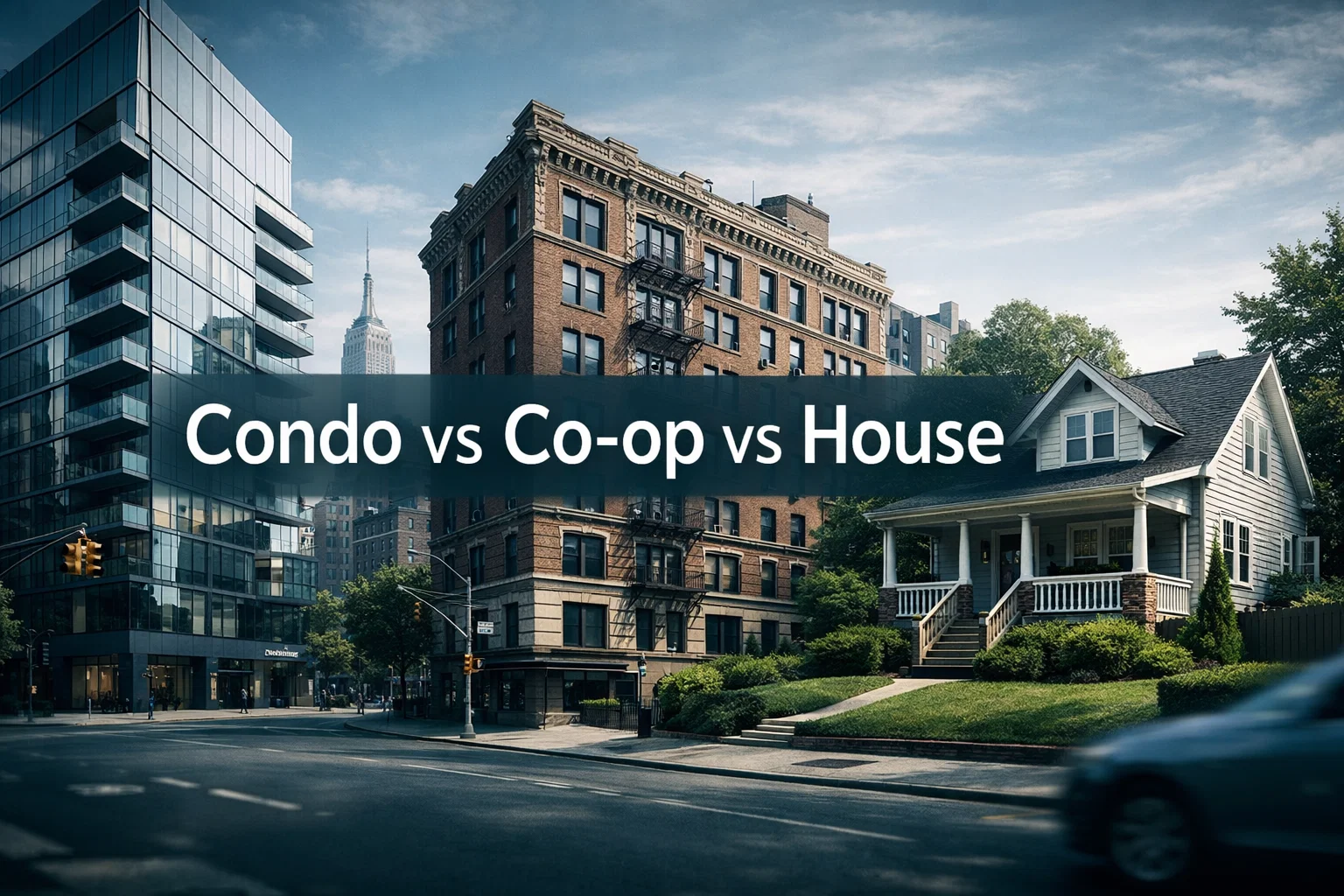
Deciding on your living preferences can often be challenging when you live in New York City. To navigate the real estate market, one has to explore the structural, financial, and lifestyle differences between Condo vs Co-op vs House to determine which investment aligns with your goals.
It is not just about choosing a good neighborhood, but various legal and financial factors are also involved. For many, a detached house with a white picket fence is an ideal choice, but for others, the convenience of a high-rise condo may be best suited. However, a third option of a co-op in a dense urban center like New York City also remains appealing for some residents.
Therefore, choosing between Condo vs Co-op vs House requires a deep dive into the nuances of ownership, monthly costs, and long-term resale value, particularly if you are considering a smart NYC real estate investment.
Understanding the Three Property Types Available in NYC
| Type | House | Condo | Co-op |
|---|---|---|---|
| Ownership | Own home and land | Own unit only | Own shares, not unit |
| Control | Full control | Some restrictions | Strict rules |
| Costs | Self-managed | Fees + taxes | Maintenance fee |
| Best For | Privacy | Convenience | Lower cost |
To further proceed with the structural analysis and understanding which might be the best option for you, we first need to closely differentiate between Condo vs Co-op vs House while also evaluating available homes for sale in NYC based on your budget, lifestyle, and long-term goals.
The Single-Family House
A house is a standalone structure, providing you with the total autonomy of making the changes whenever you desire. When you buy a house, you generally acquire “Fee Simple” ownership. This means the building is entirely yours, along with the land it sits on.
The Condominium (Condo)
A condo is a private residence located within a larger building or a community of buildings. Therefore, when buying a condo vs house, know that the former one gives you the deed to your specific unit (the “interior space”). For the rest, you share ownership of the common elements, such as the lobby, hallways, roof, and amenities, with other unit owners.
The Housing Cooperative (Co-op)
The main co-op apartment meaning is that it is not “real property” in the traditional sense. Instead of owning a deed to a unit, you own shares in a non-profit corporation that owns the entire building. Those shares allow you to live in the property on a lease. Significantly, it also provides you with the right to occupy a specific apartment.
What Is the Difference Between a Condo vs Co-op vs House?
Further understanding the core differences requires looking at four major specifications. These involve ownership, governance, financing, and maintenance.
Ownership Structure
The following is the ownership structure of Condo vs Co-op vs House:
House
Owning a house means you hold the title and deed. It is real estate in its real meaning.
Condo
In a condo, you split the deed in half. You hold a deed to your unit but are taxed individually by the municipality.
Co-op
The ownership structure of a co-op is that you hold a stock certificate. The corporation is the entity that pays the property taxes and the building’s underlying mortgage. However, you still have to pay the corporation the monthly fees.
The Approval Process
The approval process of the three main properties involves the following:
House
There is no approval process. If you have the money and a willing seller, the home is yours.
Condo
To live in a condo, you require a simple application. While the board has a “Right of First Refusal,” overall, the process is generally fast and predictable.
Co-op
The main condo vs co-op difference is that the latter has the most rigorous process. You must pass a Board Interview to get your tax returns, debt-to-income ratio, and even your personal character evaluated. Notably, they can reject a buyer for any non-discriminatory reason.
Financing and Down Payments
The following is the varying procedure followed for the down payments of Condo vs Co-op vs House:
House & Condo
Standard mortgages do apply when you consider buying a house or a condo. Therefore, you can often put down as little as 3% to 10%, depending on your credit and loan type (FHA, VA, or Conventional).
Co-op
The Co-op financing is the most complex one. You must be aware of the fact that you are not getting a mortgage on a building, but you are getting a “Share Loan.” Based on this factor, many co-op boards require a minimum of 20% to 50% down, making the entry barrier higher for those with less cash.
Cost Comparison: Condo vs Co-op vs House Ownership

The following are the monthly cost differences of a house vs co-op vs condo in NYC, helping you better understand the overall cost to buy a home in NYC beyond just the listing price.
House
You do not have to pay any extra monthly charges for owning a house. However, it is recommended that you budget for 100% of the taxes, insurance, and repairs.
Condo
You necessarily have to pay common charges for building maintenance, plus your own property taxes.
Co-op
Another significant co-op apartment meaning is that you pay a maintenance fee. This is usually higher than a condo fee because it includes your portion of the building’s property taxes and the interest on the building’s mortgage.
Pros and Cons of Buying a Condo, Co-op, or House
Once you have understood the basic structural, approvals, and cost differences of buying any of the three types of properties, next comes the major pros and cons of having a Condo vs Co-op vs House.
Single-Family Houses
As stated earlier, a single-family home is a standalone structure where the owner holds the title to both the building and the land it sits on. The following are its ownership pros and cons:
The Pros of House Ownership
- Your family gets the privacy they deserve as there are no shared walls, ceilings, or floors. You get to manage it yourself.
- Historically, detached houses appreciate at a higher rate than multi-family units because land is a finite resource.
- You do not have to take any special permissions to make renovations to the house. Essentially, you can install a solar system, re-paint your house, and make any other changes the way you like.
The Cons of House Ownership
- Overall or yearly maintenance may disrupt your budget. If the roof leaks or the HVAC fails, the bill and the logistics are entirely your responsibility.
- One of the major drawbacks of Condo vs Co-op vs House is that a house typically requires larger down payments. Significantly, they have higher absolute price tags compared to units in a managed building.
Condominiums (Condos)
A condominium is a private residence within a larger building or complex. Therefore, the main condo vs house pros and cons depend on the sharing of certain elements like halls, elevators, gyms, and roofs with other residents.
The Pros of Condo Living
- One of the major benefits of living in a condo is that you get to enjoy perks that would often be expensive in a private home. These often include a rooftop pool, 24/7 security, or a professional-grade fitness center.
- You won’t have to pay for the overall maintenance issues as the Condo Association handles snow removal, landscaping, and exterior repairs.
- Condos are often situated in prime walkable districts near employment hubs and nightlife.
The Cons of Condo Living
- When buying a condo vs house, know that for the latter, you will have to pay Monthly Common Charges. These can increase annually and are mandatory regardless of whether you use the amenities.
- If the building needs a major repair (such as a new elevator) and the reserve fund is low, owners may be asked to make a significant contribution ranging from $5,000 to $50,000+.
Housing Cooperatives (Co-ops)
Co-ops, being a unique property, are often the most misunderstood ones.
The Pros of Co-ops
- In the advantages of Condo vs Co-op vs House, the co-ops are generally 10% to 20% cheaper than condos. Essentially, this is because the buying process is more rigorous.
- The difference between a co-op vs condo in NYC is that a co-op boards often limit or bans subletting. This creates a stable community of long-term residents rather than a building full of transient renters.
- A portion of your monthly maintenance fee is often tax-deductible.
The Cons of Co-ops
- One of the major disadvantages is that co-op boards can be intrusive. They require extensive financial analysis and can reject a buyer for almost any non-discriminatory reason.
- Co-ops often require higher down payments (20% to 50% is common) and have strict rules regarding renovations and pets.
Financing and Mortgage Differences for Condos, Co-ops, and Houses
When comparing Condo vs Co-op vs House, looking only at the listing price is not enough, as current NYC Real Estate Market Trends can significantly impact mortgage rates, property values, and overall investment decisions.
Property Taxes
When buying a condo vs house, you receive a separate tax bill from the municipality. In a co-op, the property tax for the entire building is divided among the shareholders and baked into the monthly maintenance fee.
Title Insurance and Mortgages
The insurance and mortgage also vary for all three types of properties in NYC:
Condos/Houses
You must purchase Title Insurance to protect against ownership disputes. However, the overall financing is straightforward through standard mortgage products.
Co-ops
For a co-op vs condo in NYC, know that a co-op is not real property. You get a “Share Loan” rather than a traditional mortgage. Moreover, you must also know that not all lenders offer these, though major banks typically do.
Condo vs Townhouse vs House: What is the Difference Here?
Looking apart from the vertical living, people often come across the choice between a condo vs townhouse vs house in NYC. Therefore, you must be aware of the following factors:
- A House offers the most independence, as you own the entire structure and the surrounding land.
- A Townhouse serves as a middle ground. Significantly, this means you typically own the land the unit sits on, but you share side walls with neighbors and often pay a lower HOA fee for common area maintenance.
- A Condo sits at the other end of the spectrum, where ownership is limited to the interior air space of your unit.
Which Property Type Is Best for First-Time Home Buyers?

In terms of Condo vs Co-op vs House, the WL Group real estate recommends you to consider the following aspects when buying any type of property in NYC:
You Should Buy a House If:
- You have a growing family and need a yard for the children.
- You enjoy making renovations and gardening.
- You want the highest potential for long-term land appreciation.
- You value privacy above all else.
You Should Buy a Condo If:
- You are a first-time buyer wanting to build equity without the stress of exterior maintenance.
- You want to live in a downtown area.
- You might want to rent out the unit in the future (investor-friendly).
- You want luxury amenities.
You Should Buy a Co-op If:
- You plan to live in the home for 10+ years.
- You value a quiet building with long-term neighbors.
- You have a very strong, stable financial profile.
Final Thoughts on Condo vs Co-op vs House
For a condo vs co-op vs house, you must consider all implications and your family’s requirements before making a decision. Each has its pros and cons that may impact your living lifestyles in NYC. Therefore, before signing a contract, review the offering plan or conduct a thorough home inspection. Understanding the legal bones of your home is just as important as the view from the window, especially when planning or preparing for Selling Home in NYC in the future.
Frequently Asked Questions (FAQs)
Q1. Is a condo or a co-op cheaper to buy?
Generally, co-ops have a lower purchase price than condos. However, co-ops typically require a much higher down payment (often 20% to 50%) and have higher monthly maintenance fees.
Q2. Who is responsible for repairs in a townhouse?
In most cases, the homeowner is responsible for both interior and exterior repairs (like the roof and driveway). However, some townhouse communities have an HOA that handles specific exterior maintenance or landscaping in exchange for a monthly fee.
Q3. Can I rent out my property if it is a co-op?
It is much harder to rent out a co-op. Most co-op boards have strict subletting policies, such as requiring you to live in the unit for a certain number of years before renting it out, or limiting the total duration a tenant can stay.
Q4. Do I pay property taxes separately for a condo?
Yes, taxes are bundled into your monthly maintenance fee, but condo owners receive an individual property tax bill from the city or county, just like the owner of a single-family house.
Q5. What happens if a condo or co-op board runs out of money?
You will likely be hit with a Special Assessment. This is a one-time, mandatory payment to cover emergency repairs (like a new roof). Always ask for a building’s “Reserve Study” before buying.